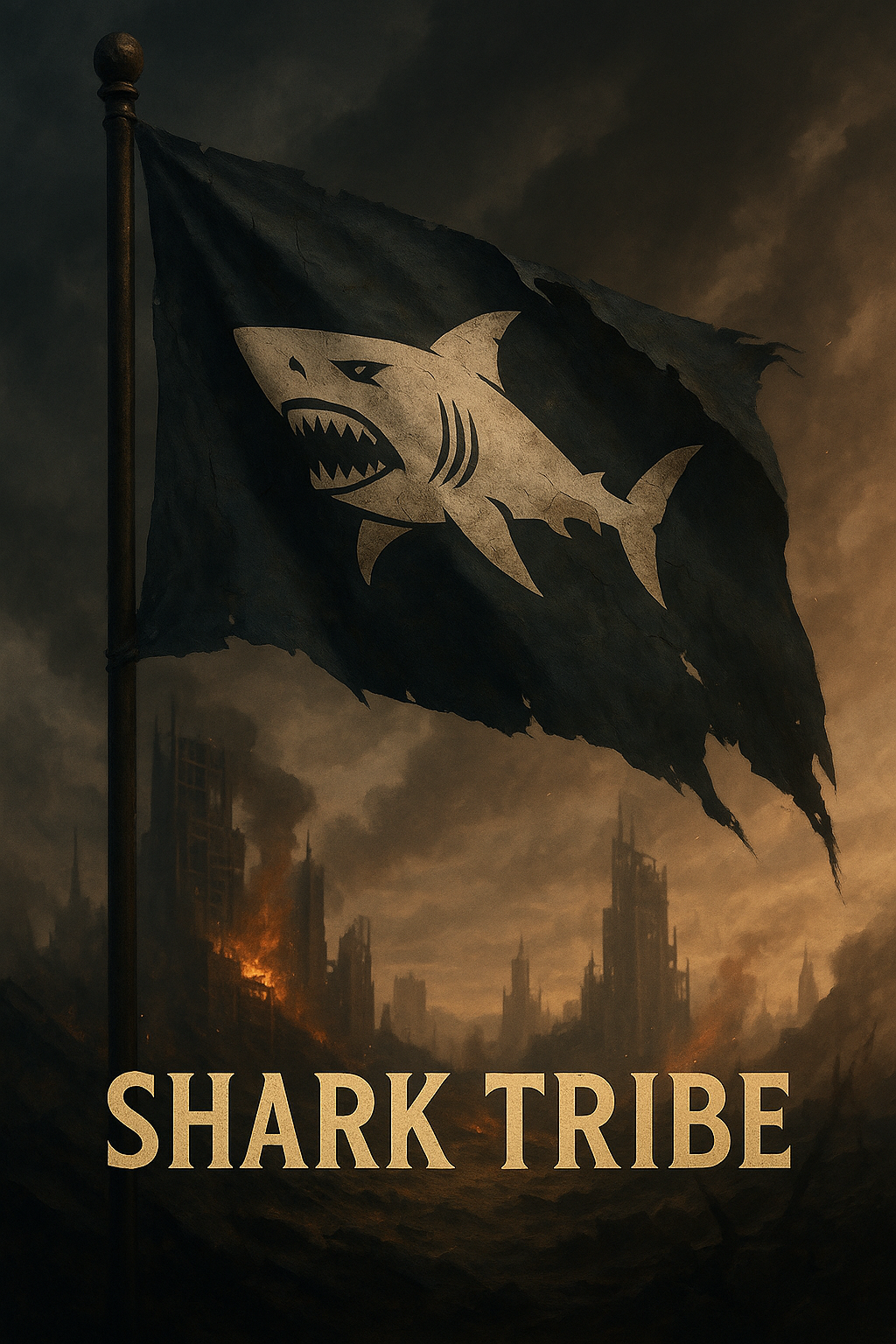

John Spence – The War Leader (Shark Tribe)
John Spence was a man built for crisis — carved by hardship, hardened by duty. Before the invasion, he was a deepwater engineer and ex-naval rescue diver, tasked with maintaining Dominion City’s underwater defense grid. The sea was his first battlefield. He’d learned long before the skies turned red that pressure could either crush a person or refine them. For John, it did both.
He earned his nickname, Shark Commander, not from arrogance but from instinct. When disaster struck offshore, he was always first into the water and last to surface. He once spent eighteen hours beneath the ruins of a collapsed turbine platform, digging survivors out of twisted metal while holding a fractured oxygen line together with his bare hands. When they pulled him out, his left arm was covered in scars from electrical burns that never fully healed.
When the alien ships made landfall, Dominion’s oceanic defenses failed within minutes. The coastal sectors were swallowed by the first wave of plasma bombardments, and John was among the few who refused to retreat inland. He knew the city’s understructure better than anyone — the tunnels, the submerged grids, the maintenance shafts that ran beneath the bay. As the world above fell, he led a group of survivors through those half-flooded corridors, guiding them by the flicker of blue bioluminescent algae that grew where light couldn’t reach. That group became the seed of the Shark Tribe — the survivors of the waterline.
Under John’s leadership, the tribe developed a unique kind of warfare. They struck fast, disappeared faster, and thrived in the flooded zones the aliens couldn’t navigate. They used the water’s reflection to mask their movements and made entire streets vanish under the illusion of calm surfaces. John’s motto was simple: “If the enemy owns the sky, take the depths.”
He wore an armored vest etched with the glowing shark insignia, scavenged from the ruins of Dominion’s naval command center. The design pulsed faintly with blue light — part aesthetic, part intimidation. His men said that when he entered battle, the glow intensified, like the heartbeat of the ocean itself.
Despite his ferocity, John carried a quiet code of honor. Every mission began with a moment of silence for those lost to the depths, a ritual he called “the breath before the dive.” His soldiers mirrored him — a synchronized inhalation before chaos. To them, he wasn’t just a commander; he was a symbol of survival.
Yet, beneath his control was grief. His younger brother, Marcus, had been stationed on one of the first defense ships obliterated in orbit. John still wore his brother’s identification tag, fused to his gauntlet by melted metal. He never took it off.
At night, when the tides were high and the alien lights shimmered on the water, John would stand on the edge of the flooded district and whisper, “The sea remembers.” The tribe said the waves moved differently when he did — as if the ocean itself was listening.

Onyx – The Enforcer (Shark Tribe)
Before the invasion, Onyx worked as a salvage diver in the southern harbors of Dominion City. His strength was legendary among the dockworkers, but so was his calm — the kind of calm that made men stop arguing when he walked into a room. They said he could haul up a car from the bay by himself, but what really set him apart was his ability to read the ocean like it was alive. He’d say, “The sea talks — most folks just don’t shut up long enough to hear it.”
When the alien ships came, Onyx was waist-deep in the flooded loading bay, hauling wreckage from an overturned transport barge. The first blast wave shattered the docks, tossing him into the black water. He woke up on the shore hours later, half-buried in debris, the world unrecognizable. The skyline burned, the sea glowed with unnatural light, and the air tasted of metal and ash.
He could’ve walked away then. But when he saw survivors trapped under the wreckage of the pier — families, workers, soldiers — something in him ignited. He built makeshift rafts from the debris, tore metal apart with his bare hands, and dragged them to safety. That night, the Shark Tribe was born around the embers of a beach fire. And at its center stood Onyx.
He became John Spence’s right hand, the tribe’s Enforcer — the man who turned discipline into survival. Onyx was a soldier without a flag, a man who believed that the only law left worth following was the one written in loyalty. When Spence needed a sector cleared, Onyx went first. When the tribe fractured under hunger or fear, Onyx was the one who stood between them and collapse.
He carried a modified speargun that he’d rebuilt into a hybrid weapon — part harpoon, part plasma rifle — forged from alien alloy and scavenged city steel. His armor bore the glowing shark emblem, not for show but as a warning: to cross the Sharks was to meet the depths.
Beneath his stoic exterior, though, Onyx carried a private guilt. Before the invasion, he’d lost his younger sister, Maya, to the ocean — a diving accident that no one had the courage to tell him was her fault. When the city fell, he swore never to lose another life to the depths again. Every person he saved, every soldier he pulled from the ruins, felt like redemption carved from saltwater.
When he spoke, his voice rumbled low and steady, like waves against stone. “The aliens think we’re weak because we breathe air,” he’d tell the new recruits. “Let them come down here. Let them drown trying.”
In battle, his presence was terrifying — a wall of motion and sound. But when the fight ended, he’d kneel beside the fallen, closing their eyes with a gentleness that no one expected.
To the Shark Tribe, Onyx wasn’t just the Enforcer. He was the tide that refused to turn back.

PLUD – The Diver (Shark Tribe)
PLUD was a man who lived where most feared to breathe — the flooded underbelly of Dominion City. Before the invasion, he had been an underwater welder and structural diver, the kind who could repair oil lines in pitch-black currents with only a headlamp and instinct to guide him. The sea was his solitude and his solace, a place where words didn’t matter and every movement meant survival.
When the aliens arrived, they struck first from the atmosphere — but Dominion’s water systems suffered just as badly. The lower districts flooded in hours, turning subway tunnels into rivers and skyscraper basements into lakes of silence. PLUD didn’t run. He went under. He salvaged, explored, and learned how the new city moved beneath the waves.
He became the Shark Tribe’s deep diver — the one who went where no one else dared. His old suit was retrofitted with scavenged alien wiring that glowed faintly blue in the dark, a constant reminder that he was breathing between two worlds: the one above, ruled by the invaders, and the one below, reclaimed by human hands.
PLUD’s face bore the weather of salt and grief. His wife had worked alongside him before the war, maintaining the city’s submerged transit seals. When the first tremor hit, she was trapped under twenty feet of water with a failing oxygen tank. He dove three times to reach her. On the third, he brought her body back — and never took off his dive suit again. He swore he would never surface until Dominion could breathe freely once more.
He became the Sharks’ recon specialist, charting the submerged ruins and finding pathways through the drowned districts. It was said that if someone went missing near the lower canals, PLUD could find them by listening to the water. “Every current has a voice,” he’d tell the recruits. “If you learn to listen, it’ll tell you who’s still alive.”
When John Spence needed someone to sabotage the alien extraction pumps that drained the city’s remaining water reserves, PLUD volunteered without hesitation. He swam alone into the pumping station, laid the charges, and surfaced twelve hours later, soaked in black oil but smiling faintly. That mission became the Sharks’ first major victory — Dominion’s first strike back.
He wasn’t loud or aggressive like Onyx. His power was quiet, methodical. He treated the water like an ally, moving through it with reverence. To his tribe, he was proof that patience could be more dangerous than rage. His voice was slow, steady, and always carried the rhythm of the tide.
On his chest plate, beneath the glowing shark emblem, were engraved the words: “Below, we rise.” It was both a memorial and a promise.
At night, when the rain mixed with the ocean spray, PLUD would stand on the sea wall, watching the reflection of the alien ships ripple across the waves. And when someone asked him what kept him diving after all this time, he would simply reply:
“Because the sea remembers what the sky forgets.”

Blackrain – The Raider (Shark Tribe)
Blackrain was the kind of man storms seemed to follow — quiet, brooding, but electric underneath. Before the invasion, he worked as a coastal patrol officer, keeping Dominion City’s outer ports safe from smugglers and pirates. He earned his name during a raid that went wrong, when a thunderstorm hit mid-mission, and he alone pushed through the black water to pull his crew back alive. After that, people stopped calling him by his real name. To them, he was just Blackrain — the storm that doesn’t stop.
When the aliens descended, he was already in the field. He saw the first ship tear through the clouds, its light breaking like lightning over the sea. His squad never made it back. Blackrain washed ashore three miles south of the port, armor scorched, lungs full of brine. He walked for two days through acid rain before he found the remnants of the Shark Tribe — or perhaps they found him, drawn by the ghost of his determination.
John Spence recognized the soldier in him immediately. Blackrain didn’t speak much, but his presence was grounding. When chaos reigned, his silence gave people courage. He was a man who measured every word before releasing it, and when he did speak, his sentences cut through panic like a blade through fog.
Blackrain’s armor was a relic of the old patrol corps, retrofitted with alien plating that shimmered faintly under the rain. He wore it like a second skin, not out of vanity, but memory. Each scratch, dent, and burn mark was a reminder — not of defeat, but survival. He refused to clean the salt from it. “The sea’s part of me,” he’d say. “If I ever wash it off, I’m done.”
His specialty was raids — precise, violent, surgical. The Sharks would move under cover of rainfall, and when the alien sensors failed in the static, Blackrain led the charge. He moved like a shadow under thunder, emerging only when the strike was complete. “If the storm hides us,” he told his fighters, “then we owe the storm our loyalty.”
Despite his cold exterior, there was something deeply human beneath. He often visited the flooded memorial district, where his old crew’s names were carved into marble now cracked and submerged. He would sit there for hours in silence, fingers brushing over the water’s surface, as if trying to feel their pulse in the tide.
When asked why he kept fighting, his answer was simple:
“Because rain always returns. And so will we.”